
Map the handoff before choosing a model
A practical way to define the inputs, decisions, owners, and destinations of an AI integration.
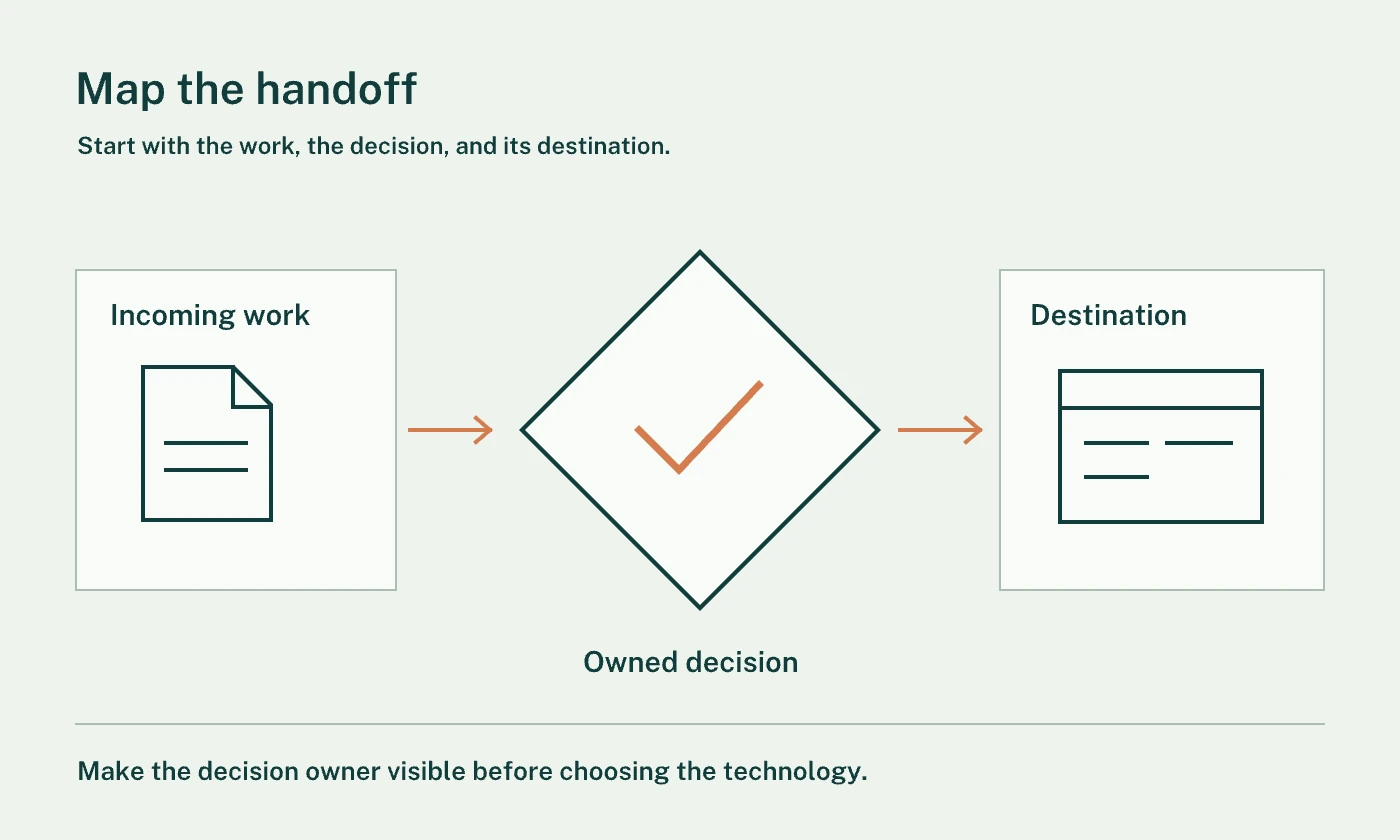
A model can help interpret information, but it cannot decide what a business process is supposed to achieve. That decision belongs to the team responsible for the work. Before comparing models, map the handoff you want to improve.
A useful map follows one item from arrival to completion. It shows what information is available, what must be decided, which system receives the result, and who takes over when the normal path breaks. This turns a broad ambition into a process that can be scoped and evaluated.
Begin with the receiving team
Start at the destination. Ask the person receiving the work what a usable handoff contains. They may need a verified supplier identifier, a clear request category, an attached source document, or a reason for escalation. Those requirements are more informative than a general request for a smarter assistant.
Work backward from that definition. Identify the source of each required field and the checks that establish whether it can be trusted. Separate information that can be looked up from information that needs interpretation. A deterministic lookup may be the strongest answer for a known identifier, even when the surrounding workflow uses AI.
Draw decisions as decisions
A process map should distinguish preparing an action from authorizing it. Extracting a bank-account field, approving a supplier, and releasing a payment are different decisions with different consequences. Combining them into one box obscures the boundary the implementation must respect.
For each decision, write down the evidence needed, the person or policy that authorizes it, and the outcome when evidence is missing. If the team cannot name an owner, resolve that responsibility before building an automated path through it.
Include the difficult route
Take a second pass through the process using an incomplete or contradictory input. Where does it wait? How is the owner notified? Can a person complete the work manually without creating a duplicate record?
These questions reveal the real scope of an integration. A missing-reference queue may need just as much design attention as the successful extraction path. The map should show the point where automation stops, the context it preserves, and the conditions required to resume.
Use the map to define a pilot
Choose a boundary narrow enough to evaluate. The pilot brief should name an intake channel, accepted inputs, permitted actions, review owner, destination, and completion signal. Add the exceptions that must be handled before the team considers the workflow usable.
NIST’s AI Risk Management Framework treats context and governance as part of managing AI risk. The process map proposed here is a practical way to make that context discussable with operations, technology, and risk owners.
Keep the finished map close to the implementation. Update it when permissions, approval rules, or source systems change. A shared description of the handoff gives everyone a way to identify whether a new issue belongs to data preparation, model behavior, a business decision, or the receiving system.