
Build an evaluation set your operations team can use
Turn real process decisions and difficult inputs into a repeatable way to judge an AI workflow.
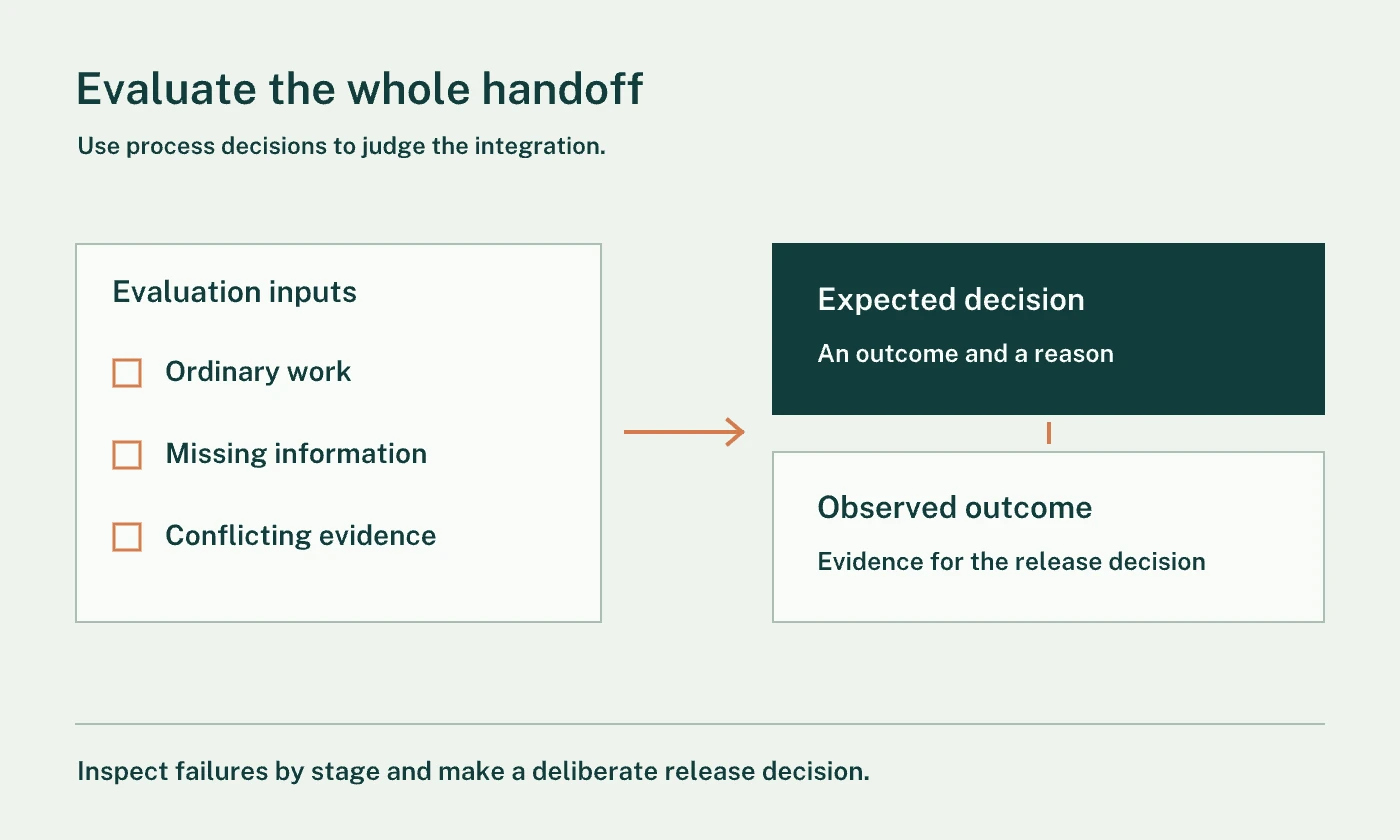
A convincing demonstration shows that a workflow can produce a useful result. An evaluation set helps establish when it does so, where it fails, and whether a proposed change improves the process. The strongest starting point is the work your operations team already knows how to judge.
Build the set around decisions and outcomes. Include the information available at the point of decision, the result the process should produce, and the reason that result is acceptable. Keep the boundary between evidence and judgment clear.
Choose cases from the process map
Take each important branch in the workflow and identify the cases that exercise it. Include ordinary inputs, missing information, contradictory values, unfamiliar formats, and items that should be escalated. If the system is expected to stop, that is an outcome worth evaluating.
Protect confidential information when preparing the collection. Where data must be altered or reconstructed, preserve the characteristics that make the case difficult: table structure, ambiguous terminology, missing references, or conflicting source passages.
Write the expected decision in operational language
A useful expectation describes the decision the team needs. “Route to the account owner because the request concerns a disputed delivery” gives reviewers more context than a label with no explanation. For document processing, identify the fields and business checks that matter to the handoff.
Allow more than one acceptable formulation where wording is not the objective. Evaluate whether an answer is supported and useful rather than requiring it to reproduce one preferred sentence. Conversely, keep exact requirements exact when an identifier, amount, or permission boundary must not change.
Separate the stages you want to diagnose
Record whether the system received a usable input, retrieved the right evidence, prepared an acceptable proposal, requested review appropriately, and completed the destination update. An end-to-end pass or fail is useful, but it may not identify the part of the process that needs attention.
The NIST AI RMF Playbook provides suggested activities aligned with governing, mapping, measuring, and managing AI risk. Its suggestions are intended to be adapted to context. The evaluation structure described here is an operational approach to discuss with the owners of your workflow, not a universal checklist.
Review disagreements instead of averaging them away
When reviewers disagree, inspect the evidence and the business rule. The disagreement may reveal an ambiguous policy or an unstated assumption. Clarify the expectation before using that case as a decisive measure of model behavior.
Keep a record of who approved an expectation and why. Revisit it when the source policy or receiving process changes. An evaluation set can become stale even if its files have not changed.
Make the set part of change control
Run the relevant cases when a model, prompt, parser, source collection, integration mapping, or approval rule changes. Add meaningful production exceptions as they arise, while keeping a stable group of cases for comparison over time.
End each review with an operating decision. Identify what can be released, what requires a human boundary, and what should remain outside scope. An evaluation set earns its place when it helps the team decide what to do next.